Search This Blog

Friday, May 18, 2012

Repetition

Definition: The act of repeating something to give it rhythm or a deeper meaning rather when it is said the first time.
Example:

Hush now little one,

The time has come,

Day has fallen into night,

Hush now little one,

Because sleep is now for you,

Please close your eyes,

And hush now little one

Significance: The significance of repetition is not widely know, but the usage of this skill in poetry can add to the rhythm of a poem and give a deeper meaning to the repeated word or phrase.


Interpretation

Definition: The explanation or meaning of something that may be different from someone else's. Such as a different point of view, especially in a poem when different people take different morals.

Example:

Change is forever there,
When nothing else lasts,
All we can do, is watch time pass.

Significance: The significance of this term is some people may take a different meaning towards the poem (such as the one above) which implys that nothing lasts; but other people may take it as, besides change, all we can do is watch time fly by.

What do you see?

Thursday, May 17, 2012

Metaphor

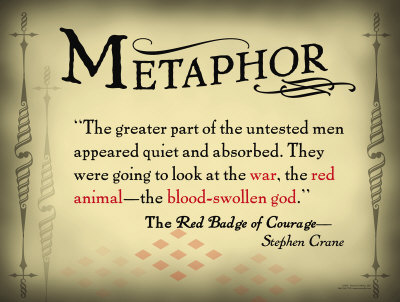
Definition: A metaphor is a figure of speech that is used to compare two unlike things as if they were literally comparable without using the words 'like' or 'as'. In poems, this is an especially useful skill that can be used to create imagery.

Example:
 His pride was that of a lion,
Where he stood tall and strong,
His face resembled a stone,
Where no cracks formed,
His will was of steel,
As it never wavered.

Significance: This term is important in poetry to create a deeper meaning to the concept of imagery. Comparing two unlike things is not as easy when you actually try to, and make it meaningful. Most people don't realize that we speak in metaphors as much as we breath.

Extended Metaphor
Definition: The comparison of two unlike things that continues for a series of sentences or lines in a poem.

Example:  
Emily Dickinson's Extended Metaphor: Hope as a "Little Bird"

"Hope is the thing with feathers
That perches in the soul,
And sings the tune--without the words,
And never stops at all,

"And sweetest in the gale is heard;
And sore must be the storm
That could abash the little bird
That kept so many warm.

"I've heard it in the chillest land,
And on the strangest sea;
Yet, never, in extremity,
It asked a crumb of me."
(Emily Dickinson)

Significance:  Being the extended version of a regular metaphor, it offers the same significance as it, except extended to several lines, or even the whole poem.


Monday, May 14, 2012

Speaker

Definition: The perspective of the person or object in the poem, rather than the author.

Example: 
She looked at her bedside with sorrow

 No one to greet her in the morrow,

She was lonely, with no one by her side,

Since he passed, going to the other world.

His story was to be foretold.

The viewpoint of this, is not my own, since I (Margaret Mendoza) am the author. This was not my own thoughts, nor have I ever been in this situation.

Significance: The significance of this term is often misinterpreted, as some people assume that the author is always the speaker; which is not always the case. This term is used to separated the author from the character(s) in the poem, or any piece of literature. Much like in prose, a poem can also have a P.O.V or a Point of View.


Thursday, May 10, 2012

Symbol

Defention: A symbol is used to represent something, be it metaphorically or literally a symbol can be a picture or used in words. A symbol can always mean something deeper than presented.

Example:
Diamond of Passion
There I stood, alone in the dark tunnel. Then I saw a light.
 Could it be? The man I have admired from a far?!
 He came up to me. My muscles were paralyzed, sweat dripped from my forehead.
 What could he want? He came closer, then I saw that he had something behind his back.
 He knelt down and presented me with a tall, skinny box. I was spell bound! He lowered his head, and then he spoke. All he could say was "here". I took the parcel from his shaking hands.
 I sat down trembling. What could it be?
 I opened the box, and there, laying in it was eleven beautiful roses!
 I've never seen anything so beautiful in all my life!
 There were five soft pink roses and five pure white roses.
 They were so beautiful, but I know that they could not last forever. But right there in the middle of them was a hand made silk rose! Its sleek beauty would last forever.
Lying there was a note, it read: "To my dearest love; we have been apart to long, but I could not confront you until now. My love for you is strong, and I hope yours is strong for me. Some say love is like a rose, beautiful when it is in bloom, but it cannot last forever. 
Whoever could say that lives in the depths of Hell.
 For love is truly like a diamond! It shimmers and sparkles beautifully, and it will continue to shine eternally! Our love shall be a diamond, whose beauty was hidden in a rock, but now that rock is open and our love shall shine forever!" I couldn't help myself! It was the most gorgeous words that I have ever heard spoken together! I couldn't help but cry! How beautiful it was! 
Then I noticed a small wrapped circle around the silk rose. I reached for it, and unwrapped the paper. There was the most beautiful thing I have truly seen! 
Even more so beautiful then the roses! It was a gold ring! But no ordinary gold ring at that. In the center of it was a rose quartz, the gem of true love, carved like a rose bud, and the ring was the stem, for the leaves of the ring were the most highly polished diamonds I had ever seen. 
They were carved like hearts. On the inside of the ring was an inscription. "Our love shall shine forever".
 I ran to him, bawling with joy. Then we kissed and he too was bawling. It was so very perfect! Then...I woke up. It was all...a dream?
 Will I ever find true love, and will it be so romantically perfect?
 I don't know. I just have to let fate work its magic! 
So I cried myself to sleep thinking that nothing will ever be as perfect as a dream.
 

-Jenni Kirby 

Authors Note:
Don't spend your life fantasizing on how wonderful love can be. That dream of yours could come true while your waiting for it. Don't think about it, let it come when it comes! Let fate do the work for you. I wrote this a long time ago...and now I know..that dreams really do come true.

Found on: http://arcadia_999.tripod.com/diamond.html 


~*~


Significance: A symbol used in poetry can represent an idea through an image created through the poem. A symbol can be tangible or intangible, and the reader can try to find out what symbols can mean or have meant.

Couplet

Defenition: A Couplet is a verse that consists of two lines that come in sucession, may or may not ryhme, or have the same length, and or topic.

Example:
In the night does the snow fall,
the stars shining for one and all.

Significance: A couplet can be used in poetry to express an idea in two lines and which are usually in relation to one another. Not all poems contain couplets that rhyme, but many often do. A couplet's ryhmes come so quickly that a reader can spot them easily.

Stanza

Defenition: A Stanza is a group of lines used to make divisions in the poem.

Example:

To The River by Edgar Allan Poe
(published 1829)

  
Fair river! in thy bright, clear flow
    Of crystal, wandering water,
Thou art an emblem of the glow
       Of beauty -- the unhidden heart --
       The playful maziness of art
In old Alberto's daughter;

But when within thy wave she looks --
       Which glistens then, and trembles --
Why, then, the prettiest of brooks
       Her worshipper resembles;
For in my heart, as in thy stream,
    Her image deeply lies --
The heart which trembles at the beam
    Of her soul-searching eyes.
~*~
The break or space after the sixth line is the end of the stanza. The new stanza begins at the seventh line; "But when within thy wave she looks."


Explanation: The term stanza is crucial in the developement of poetry. The usage of the term is important because it organizes the poem, and when a stanza is made, the group of lines together often, if not always relate to one another. The starting of another stanza is similar to a paragraph when speaking in prose.